Updates
Release 2.5.9 focuses on preparing parts for production. Nesting arrives as a tool of its own, aimed at SLS and other powder bed processes, and packs parts through the full height of a build volume rather than simply across a plate. Two new tools rebuild geometry: Alpha Shape builds meshes from point clouds, and ReWrap recovers a single clean shell from models that break booleans, offsets and slicers. Separately, Shrink Wrap conforms one mesh to the surface of another, moving its vertices onto a reference without altering its topology. Ribbon tools now link directly to their Knowledge Base articles, and the supported platforms grow to include Ubuntu 26.04 and native Windows on ARM.
Nesting: pack a build volume, not just a plate
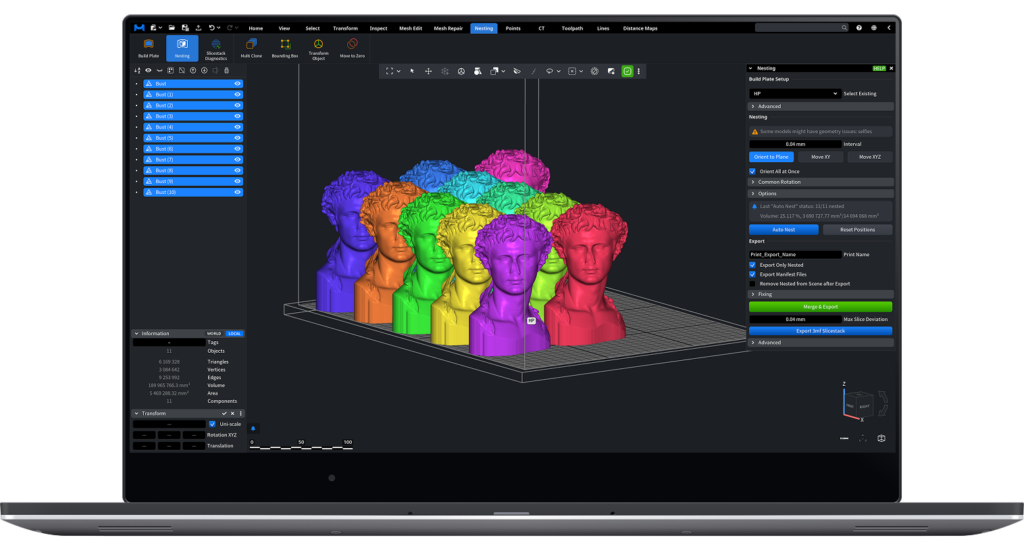
MeshInspector now packs build volumes for you. Nesting arrives as a tool of its own, on a new ribbon tab next to Mesh Repair.
It is aimed first at SLS and other powder bed processes, where the entire build volume is usable and parts need no supports. MeshInspector nests in true 3D: parts are stacked through the full height of the volume, not merely arranged across its floor. For processes that require a flat layout, 2D nesting on the plate is simply a property of the machine profile, so one tool covers both cases.
Machines are described once, as named build plate profiles: build volume, minimum clearance between parts, slicing step, and whether 3D nesting is permitted. The active profile is previewed in the scene and remembered between sessions.
Packing itself is automatic, and reports how much of the batch actually fit. Where you want influence over the result, you steer the strategy rather than the placement: order parts by volume, allow rotation, push harder or softer on neighbourhood density, nest in independent groups, and run a voxel based densification pass that compacts what has already been placed.
Before export, the whole batch can be healed in one pass, closing holes up to a size limit and dropping small stray components.
Export is 3MF, including a slice stack generated with the profile’s slicing step, with optional decimation to keep file sizes sane.
Alpha Shape: point cloud to mesh
New on the Points tab, with a single radius parameter. Picture a ball of that radius rolled over the points: every triangle it can touch becomes part of the surface. A larger radius bridges wider gaps and closes the model, a smaller one follows fine detail and leaves genuine openings open.
The surface is derived from the measured points themselves, so nothing is invented where there is no data. It is built on exact predicates, so duplicate and degenerate points do not break it, and large clouds run with progress and cancellation.
Shrink Wrap: project one mesh onto another
New on the Mesh tab. Every vertex of one mesh moves onto the closest point of a reference surface, with an optional offset outwards or inwards. Topology stays intact, and a face selection confines the effect to part of the model.
Useful for transferring clean topology onto scanned geometry, and for building conforming layers at a controlled distance such as liners, shells and packaging.
ReWrap: a clean shell from a problem model
New on the Mesh Repair tab, with one radius parameter. It resamples the surface, rebuilds it through Alpha Shape, and keeps the largest solid component, replacing the mesh in place.
It exists for models that break everything downstream: self-intersections, internal walls, duplicated shells, scan artefacts. The radius sets how much detail survives the rebuild.
Knowledge Base links inside the tools
Ribbon tools now link straight to their Knowledge Base articles, so the help for whatever tool you have open is one click away instead of a search across the site.
Other small things, useful in particular situations
- Bridge Fill All Holes, a new hole filling tool
- Clone Selection, added to the Clone drop list
- Keep Largest Component, which now lets you choose the criterion for “largest”
- Partitioner, which gained direct buttons for To Components and Select Component
Platforms
Ubuntu 26.04 joins the supported Linux targets, in both x64 and arm64 builds, alongside the existing packages for Ubuntu 22.04 and 24.04. Windows now runs natively on ARM as well as x64, and macOS covers both Intel and Apple Silicon. The AppImage builds and the browser version are updated as usual.