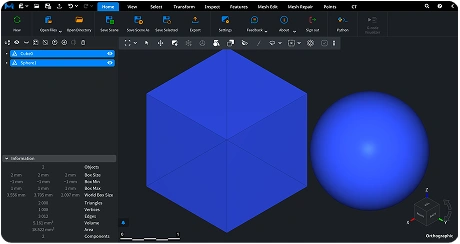

Open NC files: visualize toolpaths, check the bounding box, measure distances and angles, and review layers before sending the job to your 3D printer or CNC machine.


Watch our quick tutorial or read:
Compare popular NC viewers to find the best one for your 3D workflow.
|
MeshInspector
|
MeshInspector
|
Other STL Readers
|
|
|---|---|---|---|
| Perfomance |
Ultra-fast (GPU acceleration)
|
High
|
Slow
|
| Batch Import |
Unlimited
|
Unlimited
|
Single file
|
| File Limits |
Unlimited
|
Unlimited
|
~100 MB
|
| Measurement Tools |
Advanced
|
Advanced
|
Limited
|
| Metadata Support |
Full
|
Full
|
Not supported
|
| Scaling |
Advanced
|
Advanced
|
Not supported
|
| 3D Editor |
Advanced
|
Advanced
|
Not supported
|
| Screenshots |
Advanced
|
Advanced
|
Limited
|
| Supported Files |
STL (ASCII/Binary), OBJ, PLY, GLTF
|
STL (ASCII/Binary), OBJ, PLY, GLTF
|
STL (Binary)
|
| Export |
Multiple formats
|
Multiple formats
|
Not supported
|
| Security & Privacy |
Corporate security + Local storage
|
SSL + Auto-delete
|
Server-side storage
|
| Cross-Platform |
Windows, macOS, Linux
|
All devices
|
Web only, poor mobile UX
|
| Suitable for |
Professional & industrial use
|
Quick viewing & sharing
|
Not recommended
|
Join engineers, designers and makers who trust MeshInspector to inspect 3D models and NC toolpaths. Validate your parts and jobs with no limits and professional‑grade visualization.
Explore the full MeshInspector ecosystem — advanced 3D model viewers and converters for engineers, designers, and makers.
Engineers and manufacturing professionals regularly employ various tools to open and assess NC files. These contain the machine instructions for milling, routing, drilling, engraving, and other subtractive workflows. Because NC code defines every movement, from rapid positioning to cutting paths, a viewer is to deliver accuracy, speed, and stable performance on any operating system. MeshInspector tackles this need by offering a free and cross-platform read NC file program. You can inspect toolpaths both offline through the downloadable application and online through the browser.
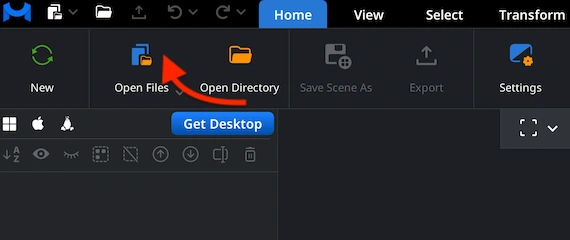
Under the ’Home’ tab, click ’Open Files.’ This option lets you load your NC file into the MeshInspector program for inspection. After you select the file, the viewer imports the complete toolpath and prepares it for visualization, regardless of how large your projects are or how many tool movements they contain.
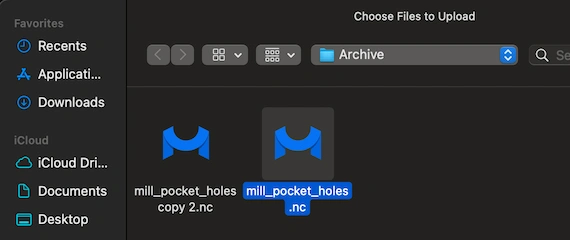
Click ’Browse.’ Navigate to the folder where your NC file is stored. Then either double-click the file or confirm the selection with Upload. The MeshInspector program for reading NC files can also open entire folders containing multiple operations, which is useful when a workflow is split into components.
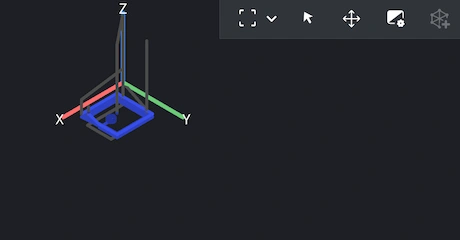
After the NC file is loaded, its toolpath appears in the viewport. You can inspect the machining trajectory from any angle. Rotation of the view is possible by dragging with the left mouse button or employing one-finger touchpad gestures. Pan the scene by holding the right mouse button or sliding two fingers on a touchpad. Zoom in or out with the mouse wheel or a pinch gesture. To tilt, hold Ctrl and drag with the left mouse button. These controls let you examine rapid positioning moves, cutting passes, vertical Z transitions, and the overall machining strategy represented in the NC program.
In the ’Inspect’ tab, you can activate ’Bounding Box’ or ’Show Dense Box’ to examine the spatial limits of your NC toolpath. Bounding Box outlines a simple axis-aligned frame that surrounds the selected motion path, giving you a clear overview of its overall footprint. Show ‘Dense Box’ computes a tight and geometry-aware envelope that follows the toolpath closely.
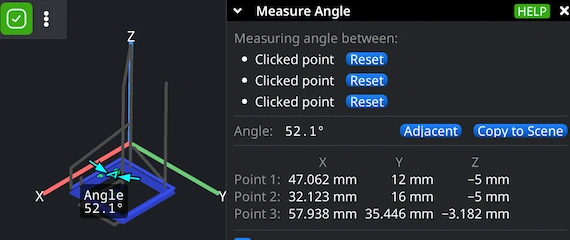
MeshInspector lets you analyze geometric relationships inside an NC with precision. To measure an angle, open the ’Measure Angle’ tool in the ’Inspect’ tab and select three points along the trajectory. After the third point is placed, the viewer immediately computes the angle and presents the result in both the viewport overlay and the measurement panel.
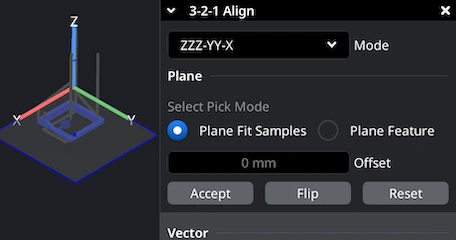
The ’3-2-1 Align’ tool in the ’Transform’ tab helps you place an NC toolpath into a stable and predictable coordinate orientation. This method is widely used to define positioning through three sequential references, i.e., primary plane defined by three points, a secondary direction set by two points, and a final axis constraint determined by one point. In MeshInspector, this alignment workflow lets you correct programs exported with unexpected rotations or offsets.

100% Secure
No data leaves your device
Integrate real-time 3D visualization, mesh analysis, and measurement tools directly into your applications with MeshLib SDK.
Modern UI — built with Dear ImGui: ribbon interface, scene tree, view cube, and measurement tools.
Order-Independent Transparency (OIT) — realistic rendering of transparent materials.
Customizable Interaction — support for mouse, keyboard, touch gestures, and SpaceMouse devices.
Plugin Architecture — extend the Viewer with your own tools and workflows.