Show Normals visualizes surface orientation by drawing normal vectors directly on the mesh. Normals indicate the direction each surface element is facing and are essential for inspecting mesh quality, shading behavior, and geometric correctness.

When enabled, MeshInspector renders short lines perpendicular to the surface at selected elements.
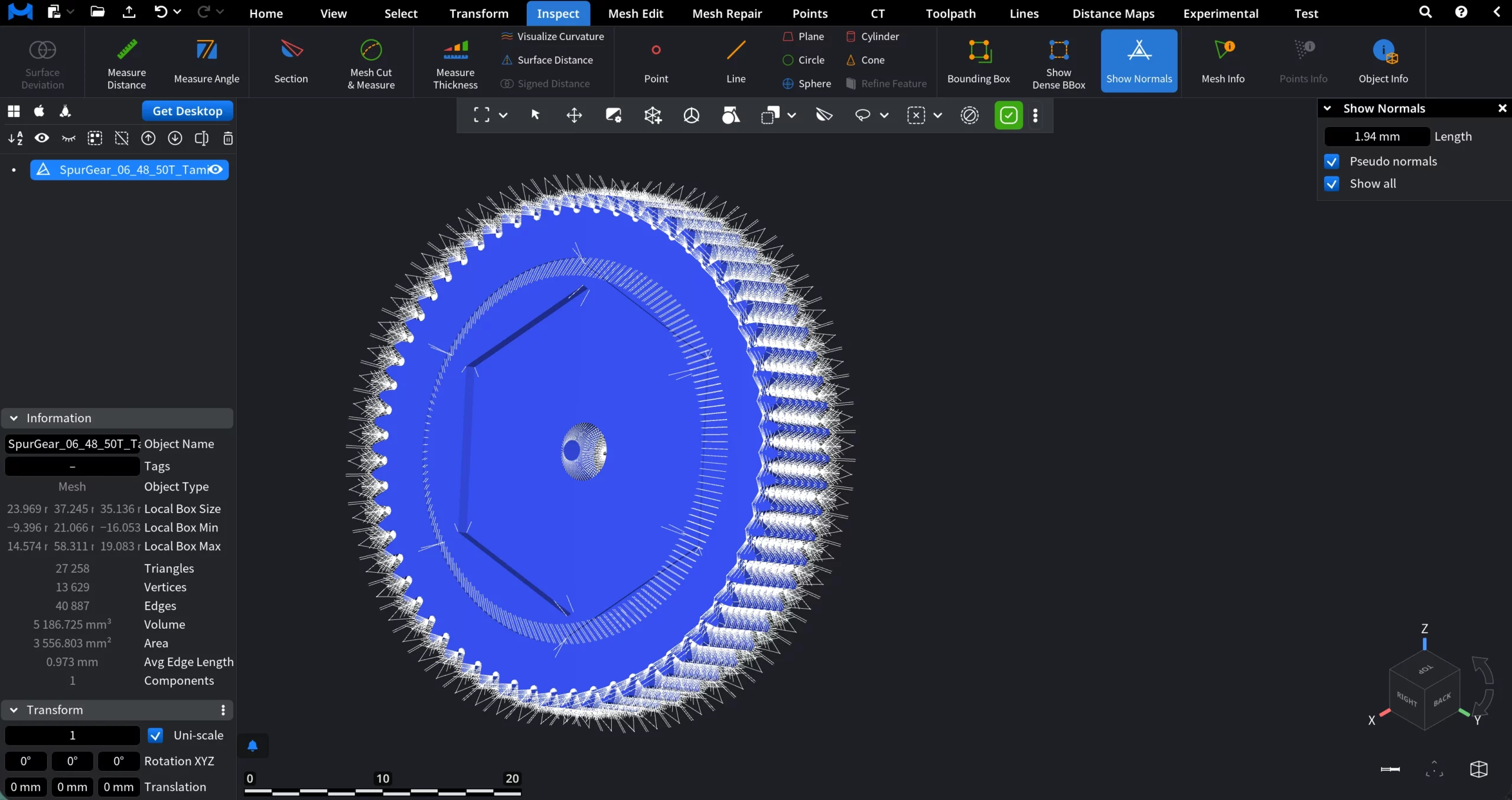
Pseudo Normals
When enabled, MeshInspector displays Pseudo Normals instead of true per-face or per-vertex normals.
Show All
When enabled, Show All displays normals for all available elements of the object at once. When Show All is disabled, you can inspect normals for specific mesh elements instead of the entire object:
- Picked Vertex ID lets you visualize normals for a single vertex by entering its vertex ID. Only the normal associated with the specified vertex is displayed. If the ID is invalid, no normals are shown.
- Show Neighbors. When enabled, normals of vertices adjacent to the picked one are also displayed.
- Length controls the visual size of the displayed normal vectors. Changing this value affects only how normals are rendered on screen and does not modify the mesh geometry.
Now, if Pseudo Normals is enabled while Show All is disabled, MeshInspector displays pseudo normals only for the selected element type and ID.
Pseudo Mode
Pseudo Mode defines which type of element is used to generate normals:
- Vertex displays a pseudo normal based on the selected vertex.
- Edge displays a pseudo normal derived from the selected edge.
- Face displays a pseudo normal based on the selected face.
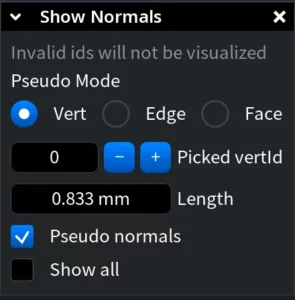
Here, the Picked vertID field specifies the exact vertex, edge, or face for which the pseudo normal is displayed.
If the entered ID is invalid, no normals are visualized.
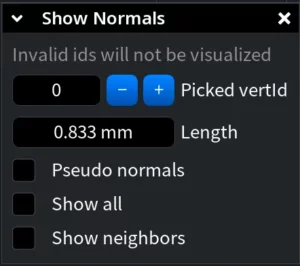
Show Neighbors. When enabled, pseudo normals of adjacent elements are displayed alongside the selected one. This helps evaluate orientation continuity across nearby geometry and identify sharp transitions or inconsistencies.
Length controls the visual size of the pseudo normal vectors.
How the Show Normals Tool Works